
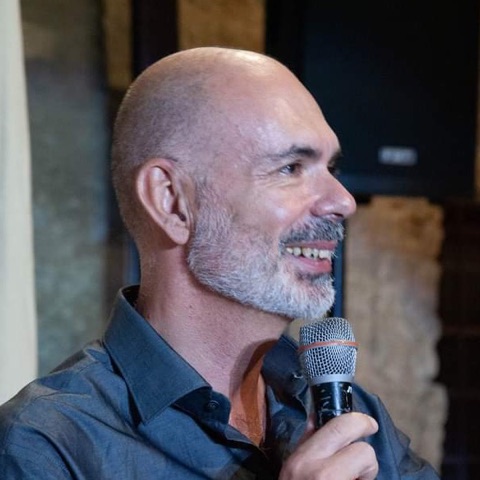
Composer, sound artist, music theorist, and academic (b. 1971).
A graduate in piano, composition, and electronic music, he pursued advanced studies with Azio Corghi at the Accademia Nazionale di Santa Cecilia and with Luciano Berio at Tempo Reale. His work spans instrumental and electronic music as well as intermedia arts, and has been presented at the Venice Music Biennale, Settimana Musicale Senese, Rai Radio 3, and international festivals. He has collaborated with artists including the Arditti Quartet, Luis Bacalov, Luca Francesconi, Giacomo Manzoni, and Steve Reich.
His research focuses on computational models for generative music and multimedia, with contributions published internationally and in the Springer volume Imagine Math.
He is Professor of Electroacoustic Music Composition at the “N. Piccinni” Conservatory in Bari, where he coordinates the Electronic Music programmes and the PhD programme in Electroacoustic Music Computation, Generative Algorithmic Models and Computational Complexity. His students have received six Italian National Arts Awards. From 2002 to 2014, he served as Assistant Maestro at the Accademia Musicale Chigiana.
CURRENT RESEARCH ACTIVITIES
Francesco Scagliola is a Full Professor of Electroacoustic Music Composition and Director of the PhD programme in Computational Electroacoustic Music Composition, Generative Algorithmic Models, and Computational Complexity at the Conservatorio di Musica “Niccolo Piccinni” in Bari, Italy.
His research lies at the intersection of mathematics, computer science, artificial intelligence, computational music theory, and complex systems.
- MATHEMATICAL STRUCTURES AND COMPUTATIONAL MUSIC THEORY
He recently published an open-access dataset on Zenodo concerning 352 pitch-class sets (PCS), including computational measures of sensory roughness and related mathematical properties. He investigates their structural relationships, statistical distributions, mathematical invariants, and applications to algorithmic composition and generative systems. He primarily uses Wolfram Mathematica for symbolic and numerical computation, graph theory, and scientific visualization.
- HIERARCHICAL GENERATIVE MODELS AND ARTIFICIAL INTELLIGENCE
He investigates computational music generation using hierarchical tree structures and attention mechanisms. His approach represents musical composition as a multilevel system, from elementary events to phrases, periods, larger formal structures, and complete compositions. He aims to develop generative systems operating both bottom-up and top-down, connecting local decisions with global musical form.
- COMPUTATIONAL COMPLEXITY AND EMERGENCE
He explores how computational irreducibility, algorithmic complexity, emergence, and nonlinear interactions can deepen the understanding of musical organization and creative processes.
- TECHNOLOGICAL GOVERNANCE AND THE RULE OF LAW
Together with Professor Antonio Felice Uricchio, former Rector of the University of Bari Aldo Moro and former President of ANVUR, he co-authored an interdisciplinary article published in a journal associated with the Italian Court of Auditors (Corte dei conti). The article examines the governance of emerging technologies, including artificial intelligence, quantum technologies, and complex computational systems.
The authors propose a methodological framework for anticipatory governance, addressing computational predictability, scientific uncertainty, legal safeguards, proportionality, and fundamental rights. A central concept is the “right to the future”: preserving human agency, accountability, and democratic oversight as technologies evolve.
- INTERDISCIPLINARY RESEARCH AND SCIENTIFIC COLLABORATION
Through the PhD programme he directs, he develops connections among computational composition, mathematics, artificial intelligence, and theoretical computer science. His goal is to build methodological bridges between artistic research and computational science.
- ADVANCED AI TOOLS FOR REPRODUCIBLE RESEARCH
He intends to use OpenAI models as research assistants in structured, verifiable, and reproducible workflows: multi-agent mathematical investigations, independent validation of results, systematic literature reviews, hypothesis generation, and research software development.
His objective is not merely to apply AI to music composition, but to discover new mathematical and computational structures, strengthen interdisciplinary research, and better understand complex generative systems.
 Zenodo
 Instagram